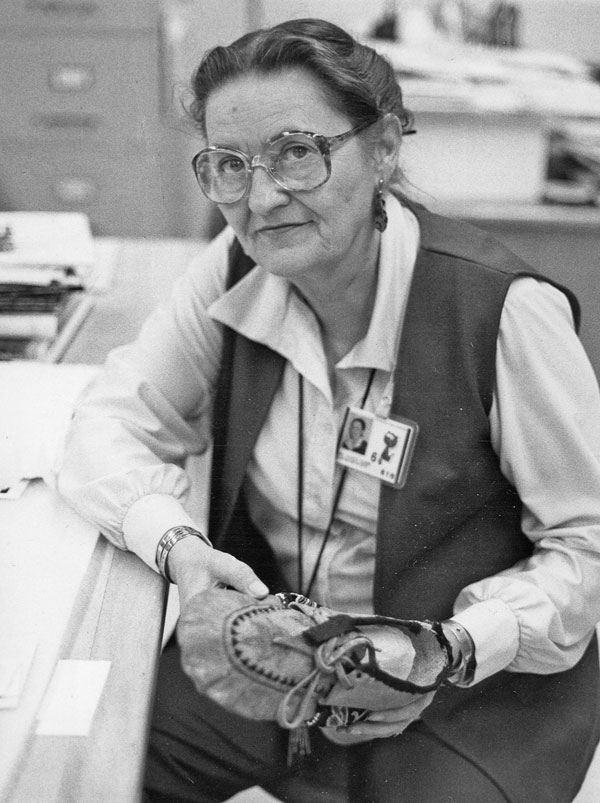
Nancy Oestreich was born on January 29, 1924, in Milwaukee. When she was eight years old, her father took her to meet the anthropologists (people who study human beings and culture) at the Milwaukee Public Museum (MPM). The visit was the beginning of her lifelong goal of becoming MPM’s head curator of anthropology.
After graduating from high school, Oestreich moved to Madison to attend the University of Wisconsin, where she majored in anthropology. During her undergraduate studies, she began her first fieldwork project, visiting and working directly with the people she was researching. She went to Winnebago communities in Wisconsin (now the Ho-Chunk Nation of Wisconsin) to learn more about their culture and ways of life from Mitchell Redcloud Sr. and other Ho-Chunk elders. Oestreich visited Redcloud often and recorded information about the Ho-Chunk Nation through his storytelling. He adopted Oestreich, gave her a Ho-Chunk name, and granted her tribal affiliation with the Ho-Chunk Nation of Wisconsin. She graduated with a bachelor’s degree in 1945.
Oestreich continued her research with the Ho-Chunk people while working on her master’s degree in anthropology at the University of Chicago; she completed the degree in 1947. She began teaching anthropology at the University of Wisconsin–Extension in Milwaukee while also working toward her PhD at Northwestern University. She married fellow student Edward Lurie in 1951. (They would later divorce in 1963.) In 1952, she earned her PhD in anthropology with a dissertation comparing Ho-Chunk cultures in Nebraska and Wisconsin.
Between 1957 and 1972, Lurie taught at the University of Michigan, the University of Aarhus in Denmark, and the University of Wisconsin–Milwaukee. At UW–Milwaukee, she served as the anthropology department chair from 1967 to 1970 and helped establish UW–Milwaukee’s first anthropology doctoral program. She served as the president of the American Anthropological Association from 1984 to 1985.
During her academic career, Lurie worked with other distinguished scholars and authored or co-authored more than 100 works, including books, chapters, and journal articles. One of her most significant publications was Mountain Wolf Woman, Sister of Crashing Thunder (1958), which tells the life story of her adoptive aunt.
In 1972, Lurie’s childhood dream came true when she accepted a curator position at MPM and became head of the anthropology section, making her the first woman to lead one of the museum’s science sections. In this role, she facilitated conversations between Native communities and MPM, encouraging Native people to participate in the creation and planning of new exhibits about their cultures. In 1993, her permanent exhibit for the North American Indian Hall, A Tribute to Survival, opened. The exhibit features a contemporary powwow, including a wide range of modern representations of seven of Wisconsin’s tribes. Lurie retired in 1994.
Lurie received many honors and awards. Most notably, she received an Honor Blanket from the Ho-Chunk Nation in 2004 and was awarded the Boas Medal from the American Anthropological Association in 2006 for her incredible contributions to the field. Nancy Lurie died on May 13, 2017.
“Nancy Oestreich Lurie on the Powwow Exhibit at the Milwaukee Public Museum” by Newberry Library, 2010
LEARN MORE
- Ganteaume, Cecile R. “Nancy Oestreich Lurie.” In Women Anthropologists: Selected Biographies, edited by Ute Gacs, Aisha Khan, Jerrie McIntyre, and Ruth Weinberg, 238–245. University of Illinois Press, 1989.
- Gleach, Frederic W., et al. Recovering Ancestors in Anthropological Traditions. Lincoln: University of Nebraska Press, 2025.
- “Nancy O. Lurie.” Wisconsin Academy of Sciences, Arts & Letters. Accessed February 11, 2026. https://www.wisconsinacademy.org/contributor/nancy-o-lurie.
Photo courtesy of the Milwaukee Public Museum.
Profile researched and written by Lee Kessler, Student Project Coordinator of Wisconsin Women Making History.