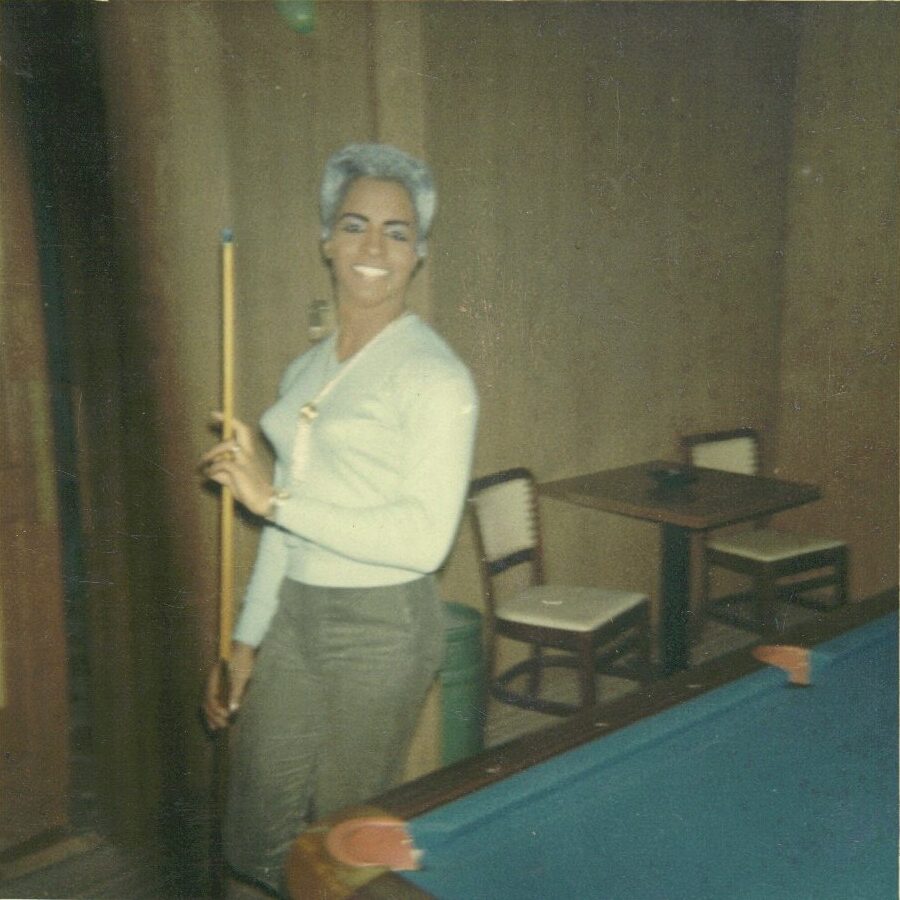
Josie Carter was born on January 16, 1938, and was raised in Milwaukee, Wisconsin. She was assigned male at birth. Her mother supported her in exploring her femininity, allowing her to wear pigtails and dresses. By the time she was 15, Carter began using the name Josie and identified as a Black queen, a common practice in the mid-20th century among Black and brown women assigned male at birth. She used the term “queen” her entire life, even as terminology like “transgender” became more common.
After serving in the Navy in the late 1950s, Carter returned to Milwaukee, where she presented as a woman in public more frequently. Although being out as LGBTQ+ in the 1950s could be challenging, LGBTQ+ people found places where they could be their authentic selves, such as gay bars. Like LGBTQ+ people of the time, these bars had to keep a low profile. In Wisconsin, it was legal to refuse to serve patrons who were known or suspected to be LGBTQ+ until 1982. Furthermore, bartenders who served LGBTQ+ people could lose their licenses, and establishments that allowed them to gather could be shut down. Milwaukee was home to many such bars by the 1960s, nonetheless.
The Black Nite was a popular gay bar in Milwaukee. On August 5, 1961, it became the site of “the Black Nite Brawl,” Wisconsin’s first known LGBTQ+ uprising, led by Carter. Early that evening, four sailors were dared to enter the bar as a homophobic joke. When the bouncer, Carter’s partner Wayne, asked them to show their IDs and to sign the bar’s registration book—a common practice at gay bars at the time—the sailors refused and started a fight. When Carter saw this, she approached them and broke a bottle over one of the sailors’ heads. The four men retreated but warned Carter and Wayne they would be back.
As the night wore on, the bartender urged patrons to leave for their safety. However, Carter persuaded many of them to join her in the fight against the sailors. As promised, nearly a dozen sailors came to the bar, but they were unprepared for the force of over 70 patrons awaiting them. Though much of the bar and its furniture was destroyed, the sailors ultimately lost the battle. The police arrived and unexpectedly arrested the sailors rather than the patrons.
Newspaper coverage of the Black Nite Brawl helped make LGBTQ+ people in the city more visible. A common stereotype at the time was that gay people were weak, but the Brawl redefined them as strong people who would do whatever it takes to defend their community.
In the years that followed, Carter remained a key figure in Milwaukee’s LGBTQ+ community. In 1962, her son was born. However, he was not her only child; Carter became known as the “Mother of Gay Milwaukee” after years of informally adopting and mentoring countless abandoned LGBTQ+ youth in the city. She was a celebrated elder among younger LGBTQ+ people in Milwaukee’s booming drag and ballroom scene. Even after she stopped performing in drag shows in the 1970s, she remained a staple of the community, running a bar from her basement and providing a safe place for people to gather.
Carter died of cancer on May 29, 2014. In 2022, the site of The Black Nite was designated a historic landmark, making it the first in Wisconsin to honor a Black transgender person.
LEARN MORE
Carter, Josie, and Jamie Gays, “Oral History Interview with Josie Carter and Jamie Gays, May 6, 2011,” interview by Brice Smith, Oral History Interviews of the Milwaukee Transgender Oral History Project, Mar 6, 2011. Audio, 1:09:54. https://collections.lib.uwm.edu/digital/collection/transhist/id/24/
Imig, Nate, and Michail Takach. “Meet the gender nonconforming ‘queen’ who led Wisconsin’s first LGBTQ uprising.” Produced by Radio Milwaukee. Be Seen. March 23, 2022. Podcast, MP3 audio, 31:57. https://radiomilwaukee.org/story/uniquely-milwaukee/meet-the-gender-nonconforming-queen-who-led-wisconsins-first-lgbtq-uprising/
Schwamb, Don. “Black Nite Brawl Incident and Josie Carter.” Wisconsin LGBTQ History Project. August 2024. https://archive.wislgbthistory.com/events/black-nite-brawl.htm
Takach, Michail, and B.J. Daniels. A History of Milwaukee Drag: Seven Generations of Glamour. American Heritage, 2022.
Photo courtesy of the Wisconsin LGBTQ History Project.
Profile researched and written by Lee Kessler, Student Project Coordinator of Wisconsin Women Making History.