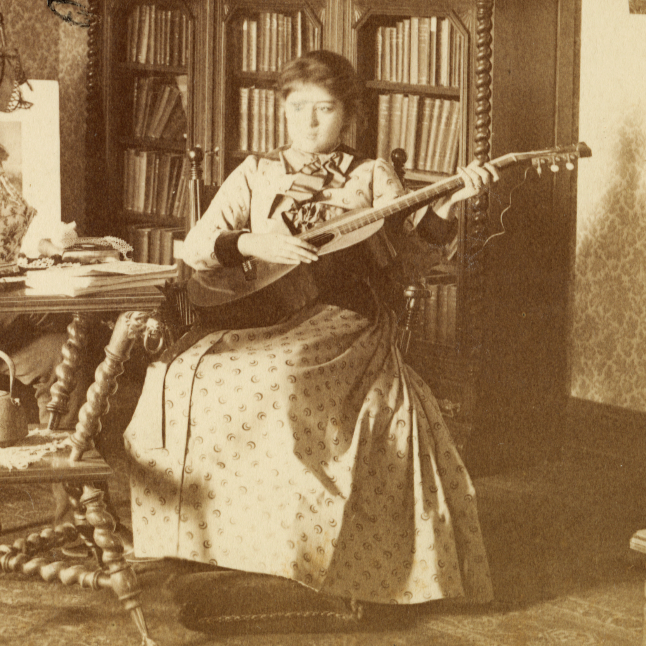
Rachel Szold was born in Baltimore, Maryland, on November 30, 1865. In 1888, shortly after graduating from the all-girls Western High School, Szold married Joseph Jastrow, a psychology student at Johns Hopkins University. Later that year, Joseph was hired as the first psychology professor at the University of Wisconsin in Madison. After moving to Madison, the couple lived in a small two-room space in the Ladies’ Hall dormitory.
The Jastrows liked to be involved in their local community. The couple actively promoted the arts in Madison. They also believed science should not be limited to higher education and enjoyed hosting Joseph’s students in their home to get to know them better. They even moved to a larger home to accommodate more guests. Rachel Jastrow enrolled in classes at the university and joined organizations, such as the Madison German Society, the Civics Club, and the University League.
Between the late 1890s and the early 1900s, Jastrow was a member of the Madison Woman’s Club. During this time, she served on several committees, including the Art, Literature, and Philanthropy Committees. In 1911, she was appointed president of the club and served in that position for two years.
A scholar in her own right, Jastrow translated two books into English: The Individualization of Punishment, from the second French edition in 1911, and The World’s Legal Philosophies, from German in 1912.
In 1914, Jastrow co-founded the Madison chapter of Hadassah, the Women’s Zionist Organization of America, which was started by her sister, Henrietta Szold. One of Hadassah’s priorities was raising funds to support medical care in Palestine. Jastrow served as the Madison chapter’s first president for two years. She remained an active member until her death.
Jastrow also founded a hospital association in 1898, a group that raised money for a hospital. This led to the construction of the city’s first hospital, Madison General Hospital, which opened in 1903. During the 1918 influenza epidemic, she volunteered as a nurse at the hospital. During this time, the Jastrows adopted Benno, an orphaned boy who had survived the epidemic.
Some of Jastrow’s most important work was in the area of women’s rights. She strongly supported women’s suffrage, or the right to vote, and became one of the leaders of the suffrage movement in Madison. She was an active member of the Wisconsin Woman Suffrage Association and, among other roles, served as the Legislative Chairman. In this role, Jastrow communicated developments in the state government to the association so progress could be made. She also gave speeches in support of women’s suffrage, at times from an open vehicle with a “Votes for Women” banner hanging from the back.
After an illness, Rachel Jastrow died on September 12, 1926. The Madison chapter of Hadassah was renamed the Rachel S. Jastrow Chapter in her honor.
LEARN MORE
Kohler, Ruth De Young. The Story of Wisconsin Women. Kohler, WI: The Committee on Wisconsin Women for the 1948 Wisconsin Centennial, 1948.
Levin, Alexandra Lee. “The Jastrows in Madison.” Wisconsin Magazine of History, Summer 1963. https://explore.wishistory.org/asset-management/20HWMK0OGAXI?WS=SearchResults.
Swarensky, Manfred E. “Rachel S. Jastrow Chapter of Hadassah.” In From Generation to Generation: The Story of the Madison Jewish Community, 1851-1955, 77–79. 1955.
Photo courtesy of the Wisconsin Historical Society archives, W0134AV.
Edited by Emma McClure, student coordinator of the Wisconsin Women Making History project, and Kelsey Foster.