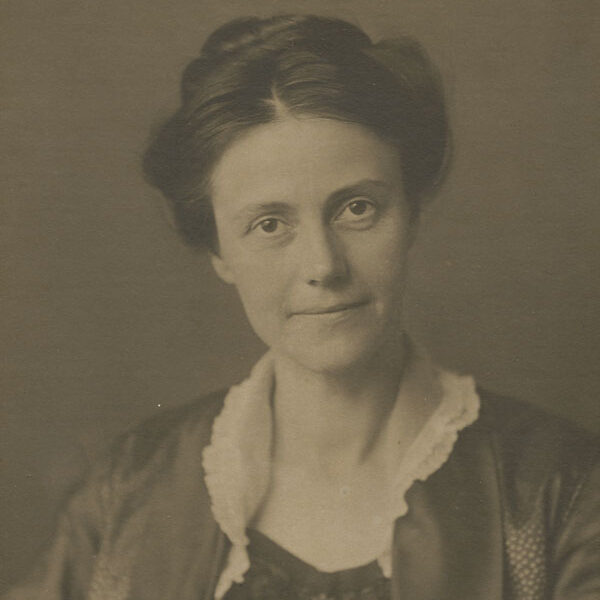
Julia Grace Wales was born on July 14, 1881, in Bury, Canada. After completing a bachelor’s degree at McGill University in 1903 and a master’s degree in English at Radcliffe College in 1904, she came to the United States to teach English at the University of Wisconsin in Madison. After war erupted in Europe in August 1914, Wales wrote an essay called “Continuous Mediation Without Armistice.” In it, she proposed that the U.S. organize a group of representatives from countries not at war to act as mediators for the countries at war. The representatives should be experts in their fields — science, economics, education, religion — but not government officials. “Without Armistice” meant that these peace talks should take place while the war was still ongoing, rather than waiting for one side to surrender, in hopes of ending the violence more quickly.
Worried that her plan would not be accepted if people knew it was written by a woman, she first published her essay in an anonymous pamphlet. The Wisconsin Peace Society and the Wisconsin Legislature adopted her position, and national peace organizations incorporated her message into what came to be known as the Wisconsin Plan.
In spring 1915, Wales herself presented the Wisconsin Plan to the International Congress of Women in the Netherlands, which unanimously adopted the plan. Afterward, Wales and other delegates from the Congress traveled around Europe to spread the idea of forming a global peacemaking organization, as outlined in Wales’s essay. They met with government officials and heads of state, even those from countries actively fighting the war. Because many members of this group were women and none were politicians, the media often ridiculed their efforts to make world peace. Even so, Wales’s idea has been credited with laying the foundation for international peace organizations like the United Nations.
After the U.S. entered the war in 1917, Wales returned to her academic career in Wisconsin. She taught Shakespeare courses in England from 1919 to 1921 before returning to the U.S. In 1926, she earned a PhD in English and Italian from the University of Wisconsin and was promoted from instructor to assistant professor. She wrote a textbook called Democracy Needs Education, published in 1942, as well as poetry and other texts. In 1947, Wales retired and returned to Canada, where she died on July 15, 1957, at the age of 76.
LEARN MORE
Sharer, Wendy B. “Continuous Mediation: Julia Grace Wales’s New Rhetoric.” In Ann George, M. Elizabeth Weiser, and Janet Zepernick, eds., Women and Rhetoric between the Wars. Southern Illinois University Press, 2013, pp. 19–31.
Trattner, Walter I. “Julia Grace Wales and the Wisconsin Plan for Peace.” Wisconsin Magazine of History, vol. 44, no. 3 (Spring 1961), pp. 203–213. https://explore.wishistory.org/asset-management/20HWMK0O3RYD?WS=SearchResults.
Wales, Julia Grace. Continuous Mediation without Armistice: A Development of the Idea of a Continuous Conference of Neutral Nations, Which Has Occurred Independently to Others besides the Author of the Pamphlet. Woman’s Peace Party, 1915. https://babel.hathitrust.org/cgi/pt?id=uc1.31175035183972&seq=14.
Photo from Library and Archives Canada, e002343766.
Profile drafted by Laurie Buccholz and edited by Kimberly Heute and Kelsey Foster.