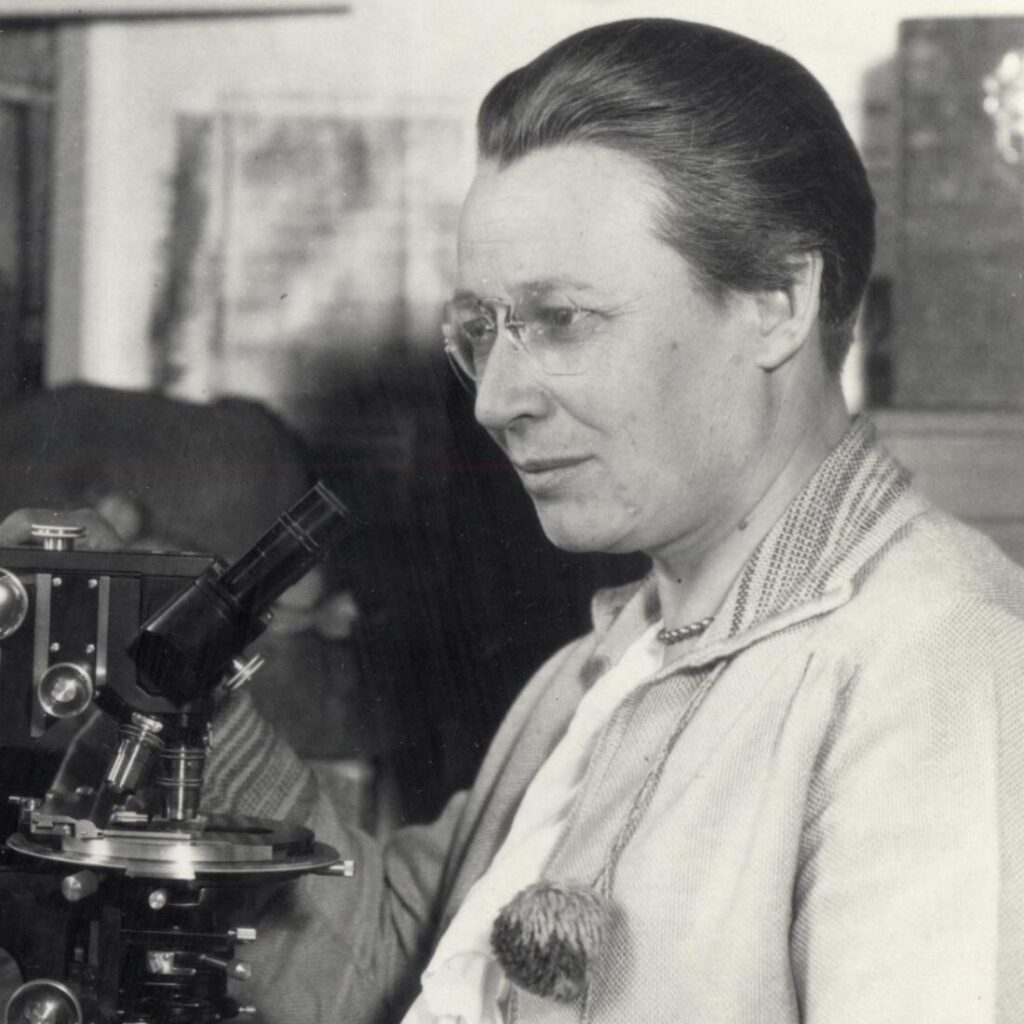
Eloise Gerry was born on January 12, 1885, in Boston, Massachusetts. She attended a small country school in the foothills of the White Mountains between New Hampshire and Maine, where a teacher encouraged her to learn about local trees, wildflowers, and birds. Later, she studied chemistry at Radcliffe College (now the Harvard Radcliffe Institute), a women’s college. Gerry graduated from Radcliffe with a bachelor’s of science in 1908 and a master of arts degree in 1909.
On June 10, 1910, Gerry moved to Madison, Wisconsin, to work as a research scientist at the U.S. Forest Service’s newly established Forest Products Laboratory. She was the first woman scientist the Forest Service hired, thanks to her training in specialized woodcutting and her ability to photograph tiny things seen through a microscope. After five months, she became the first certified woman microscopist in the country, professionally using microscopes to analyze samples.
During her 44 years at the Forest Service, Gerry worked on many projects. Despite being told by supervisors that the forests were “no place for a woman” (Havlick n.d.), Gerry went out to collect samples for a project on harvesting turpentine, a liquid that comes from the resin produced by pine trees. She traveled through the forests of Mississippi, Georgia, Alabama, Louisiana, and Florida on foot, on horseback, and by car. From this research, she discovered a resin-harvesting method that enabled more resin to be collected and was better for the trees. She shared this harvesting method with lumberjacks in the industry during her annual presentation on her research.
During both world wars, she worked with the National Defense Program and the naval stores industry. “Naval stores” refers to materials obtained from trees used for building warships and aircraft. Her work on resin harvesting improved naval store extraction methods, enabling naval store stations to operate year-round. During World War II, Gerry wrote about better ways to use wood for trainer aircraft and gliders to reduce waste. After the war, she took over a project researching the properties and habitats of various types of wood around the world.
In 1921, Gerry earned her PhD in botany and plant pathology from the University of Wisconsin in Madison. She later became an assistant professor at the University, where she taught about wood structure and identification. Gerry was a member of many professional organizations, including Sigma Delta Epsilon (SDE), now Graduate Women in Science, an organization dedicated to empowering women in science. In 1925, she served a one-year term as the SDE national president. After many years of helping develop the organization’s Fellowships Fund, she was awarded honorary membership in 1957. She retired from both academic and forestry work in 1955.
In retirement, Gerry became one of the country’s first breeders of Basenji dogs and supported the Dane County Humane Society and Badger Kennel Club. She also traveled the world with her partner and fellow academic, Susan Ballou.
Gerry died on December 11, 1970. She left the majority of her estate to Graduate Women in Science.
LEARN MORE
“Eloise Gerry.” Found in the University Archives. January 6, 2017, https://uwmadarchives.tumblr.com/post/155487405654/eloise-gerry
“Eloise Gerry Fellowship.” Graduate Women in Science, https://www.gwis.org/page/GerryEndowment
Havlick, David. “Dr. Eloise Gerry.” Forest History Society, https://foresthistory.org/research-explore/us-forest-service-history/people/scientists/dr-eloise-gerry/
McBeath, Lida W. “A Woman of Forest Science.” July 1978, https://foresthistory.org/wp-content/uploads/2017/01/EloiseGerry.pdf
Schrager, Adam. “Eloise Gerry.” On Wisconsin, 2018, https://onwisconsin.uwalumni.com/bygone/eloise-gerry/
Photo courtesy of he Board of Regents of the University of Wisconsin System; UW–Madison Digital Collections, S08907.
Profile written by Emma McClure and edited by Lee Kessler, Student Coordinators of Wisconsin Women Making History.