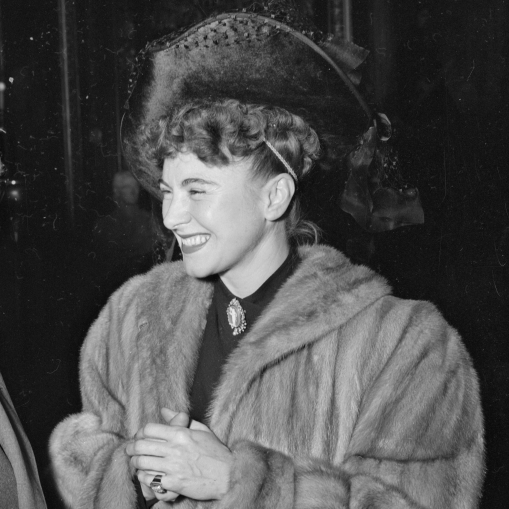
Hildegarde Sell was born on February 1, 1906, in Adell, Wisconsin, and grew up in New Holstein. She and her sisters sang in the school choir and played in the orchestra. When she was 12, her family moved to Milwaukee. After graduating from high school, she set her sights on becoming a concert pianist. In 1924, she studied piano at the Marquette University College of Music and found a job playing piano for silent movies. Unfortunately, she could not afford the program and dropped out of school in 1925. In 1926, she attended a vaudeville show (a variety show with music, comedy, and dance, popular in the early 1900s) called “Jerry and Her Baby Grands.” After the show, she went backstage and asked to audition. Three weeks later, she was hired. She toured with them for two seasons, then accompanied other vaudeville artists for several years.
In the 1930s, she moved to Europe with her manager, Anna Sosenko, a songwriter and one of the first women to work as a talent manager in the music industry. In 1933, they moved to Paris and spent three years there honing Sell’s act. She learned to sing in French, Russian, Swedish, German, and Italian, and she began to develop her distinctive performance style, with glamorous gowns, white gloves, and roses passed out to the audience. Sosenko negotiated a long-term contract with BBC Radio for Sell, becoming the first American to secure such a deal. She continued to perform at hotels and clubs across Europe. Sell was one of the first performers to popularize going by one name—she was known as “The Incomparable Hildegarde” or simply Hildegarde.
Eventually, Sell and Sosenko returned to the United States. They lived in New York City, and Sell traveled around the country to perform in cabarets and supper clubs (restaurants and nightclubs with live entertainment). In the 1940s, she worked as a singer and pianist for many radio shows and eventually hosted her own show, The Raleigh Room. During the peak of her 70-year career, she was the highest-paid cabaret singer in the world and performed at least 45 weeks a year. Eleanor Roosevelt called her the “First Lady of Supper Clubs.” She even sang for the Pope, King George VI of England, and two U.S. presidents.
Sell remained fairly popular even as music tastes changed. In the 1950s and 1960s, she made many appearances on TV game shows and talk shows. She published an autobiography in 1961 called Over 50… So What! She returned to Wisconsin many times over the years to perform, including three shows at Mount Mary University in Milwaukee. Mount Mary awarded Sell an honorary degree in 1993, and she donated clothes and accessories to their Fashion Archive.
Sell continued to perform live for many years in Europe and the U.S., and she sold out Carnegie Hall at 80 years old. She finally retired in 1998 at age 89. Sell died on July 29, 2005, at the age of 99.
LEARN MORE
Bernstein, Adam. “Cabaret Performer Hildegarde Dies at 99.” The Washington Post, August 1, 2005. http://www.washingtonpost.com/wp-dyn/content/article/2005/07/31/AR2005073100965_2.html?noredirect=on.
Hawtree, Christopher. “Hildegarde.” The Guardian, August 3, 2005. https://www.theguardian.com/news/2005/aug/03/guardianobituaries.artsobituaries
Marquette University Raynor Library. “Hildegarde (Loretta Sell) Papers Scope and Content.” n.d. https://www.marquette.edu/library/archives/Mss/HLS/HLS-sc.php.
The Mount Mary University Fashion Archive. “Hildegarde.” Mount Mary University Digital Collections. Accessed Dec 10, 2025. https://digitalcollections.mtmary.edu/exhibits/show/mountmaryuniversityfashionarch/digitalfashionarchive/wardrobesandevents/hildegarde.
Photo courtesy of the Wisconsin Historical Society archives, W011TBD.
Profile written by Emma McClure, student coordinator for Wisconsin Women Making History, and edited by Kelsey Foster.