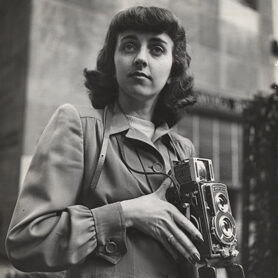
Esther Bubley was born on February 16, 1921, in Phillips, Wisconsin, to Eastern European Jewish immigrant parents. After some time in New York, the family settled in Superior, Wisconsin. Bubley’s interest in photography began at Superior Central High School, where she took her first photography class. She studied photography at Superior State Teachers College (now University of Wisconsin–Superior) before taking a one-year photography program at the Minneapolis School of Art (now the Minneapolis College of Art and Design).
When she began her career as a professional photographer, Bubley struggled to find work in the male-dominated field. In 1941, she moved to New York to work for Vogue magazine and then relocated to Washington, D.C., to work at the National Archives. Her career took off when she was hired by Roy Stryker, the head of photography at the federal Office of War Information (OWI), in 1942. She first worked as a darkroom assistant helping develop photos, but was encouraged by Stryker to complete photography assignments for the OWI. In 1943, Bubley left the OWI with Stryker to work for Standard Oil of New Jersey, where she completed two of her most well-known photography projects.
First, in 1945, Bubley spent six weeks in Tomball, Texas, a town that underwent significant economic change and growth after the discovery of oil. There, she spoke to and photographed residents to show what their lives were like. Second, in 1947, Bubley produced her photography series “Bus Story.” This project highlighted the importance of buses in long-distance travel across the US and depicted different forms of agricultural and industrial labor in the post-war era. Also in 1947, Bubley returned to Superior to photograph industrial activity there for Standard Oil.
Throughout her career, Bubley worked as a photographer for magazines such as LIFE and McCall’s, as well as for corporations including Pepsi-Cola and Pan-American World Airways. This work took her all over the world. In 1951, she was hired to photograph the Pittsburgh Children’s Hospital. In 1953, the United Nations Children’s Fund hired her to create a photo essay about the treatment of trachoma, an eye disease, in Morocco. Bubley’s most ambitious project was her contribution to “How America Lives,” a long-running series of articles about American families published in Ladies’ Home Journal.
In the 1960s and 1970s, Bubley published many books demonstrating a shift in focus from depicting the lives of US families to nature and animals. Bubley’s work has since been featured in the Museum of Modern Art in New York City, the Library of Congress, and more. In 1991, she received an honorary doctorate from the Minneapolis College of Art and Design. Esther Bubley died from cancer on March 16, 1998.
LEARN MORE
“Esther Bubley.” Howard Greenberg Gallery, http://www.howardgreenberg.com/artists/esther-bubley?view=slider.
“Esther Bubley Up Front.” National Museum of Women in the Arts, May 21, 2020, https://nmwa.org/exhibitions/esther-bubley-front.
Kynoch, Gabrielle. 2020. “Esther Bubley.” Hundred Heroines, November 29, https://hundredheroines.org/historical-heroines/esther-bubley/.
“Women Come to the Front: Esther Bubley.” Library of Congress, July 27, 2010, https://www.loc.gov/exhibits/wcf/wcf0012.html.
Yochelson, Bonnie. n.d. “Biography of Esther Bubley.” Esther Bubley. https://www.estherbubley.com/bio_frame_set.htm.
Photo Credit: John Vachon, 1944. Used by permission of Jean Bubley.
Profile written by Emma McClure and edited by Lee Kessler, Student Coordinators of Wisconsin Women Making History.