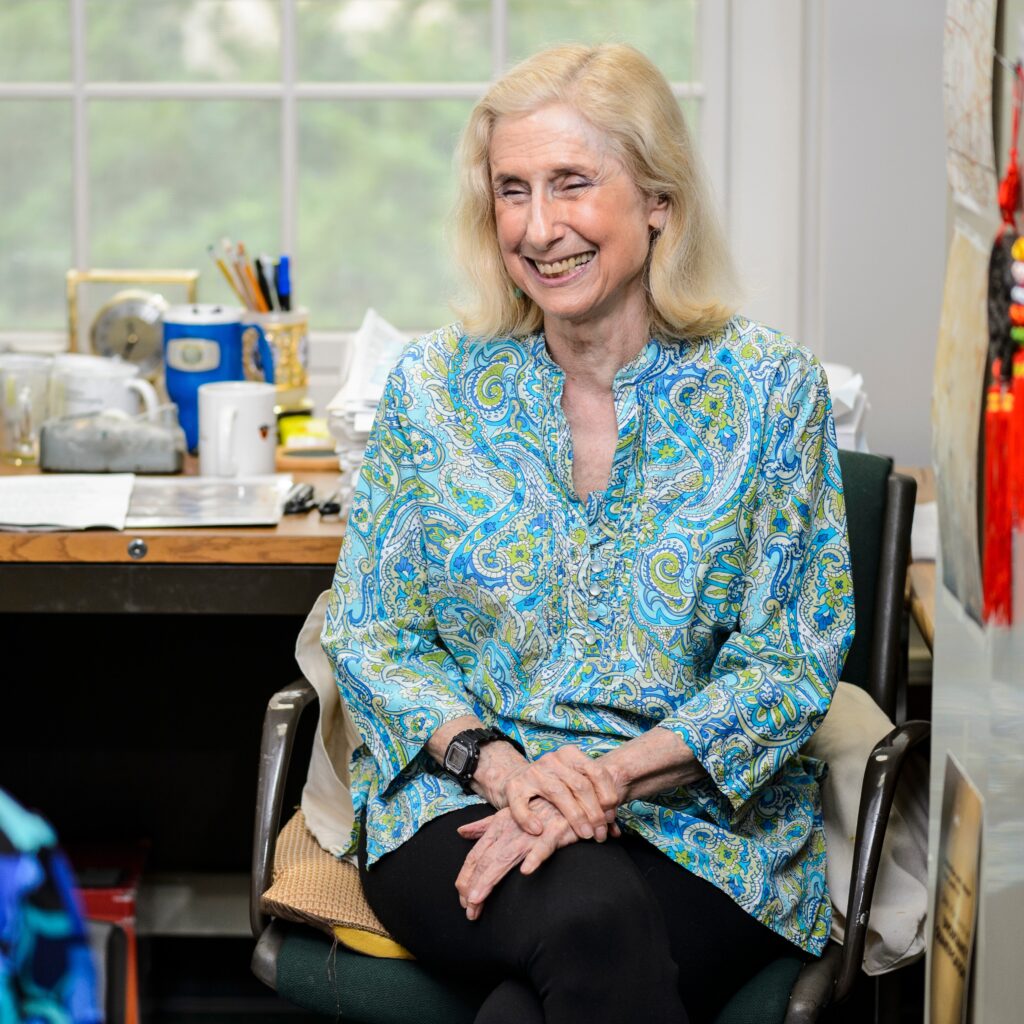
Grace Wahba was born on August 3, 1934, in Washington, D.C. Her family frequently moved during her childhood, but they settled down in Montclair, New Jersey, by the time Wahba began high school. At Montclair High School, she was the only girl in her statistics class and the only girl invited to take an advanced math class on probability.
In 1952, Wahba began studying math at Cornell University, the only Ivy League school, other than Brown University, to admit women at the time. Wahba was frequently the only woman in her classes. She impressed her professors with her determination and mathematical ability and was invited to take a special calculus class. By the start of her senior year, Wahba was married and pregnant with her son, who she gave birth to shortly after graduating in 1956.
That same year, Wahba and her family moved to Bethesda, Maryland. Despite her husband’s wishes, she got a job, first teaching math at the University of Maryland, College Park, and later working on calculations at Operations Research, Inc. While working, she pursued a master’s degree in math from the University of Maryland, College Park, which she obtained in 1962. Soon after, her husband got a job in Boston, Massachusetts, but Wahba didn’t want to move. The two separated.
After working at Operations Research, Inc. for nearly five years, Wahba left for a higher-paying position at IBM in Washington, D.C. IBM made significant technological advancements in the late 1950s. They developed large computers to process mass amounts of data. In 1965, Wahba discovered a mathematical formula to improve satellite data collection while working at IBM. Her formula helped determine the best way to position a satellite to record data about a specific object or place in space, such as a particular spot on the moon. It came to be known as Wahba’s Problem and has been referenced in thousands of published scientific papers. IBM eventually moved Wahba to California, where she continued working while pursuing her PhD in statistics at Stanford University.
Wahba completed her PhD in 1966. In 1967, she accepted a teaching position at the University of Wisconsin–Madison, becoming the first woman to join the faculty in the Department of Statistics. She worked at the university for 51 years. Over the years, she advised 39 graduate students. Many of them now teach at prestigious institutions, and they describe Wahba as a motivating advisor and an inspiration to women in the fields of science and technology. Wahba is known for her work in data smoothing (making data easier to observe for patterns or trends), even writing an influential book on the subject, Spline Models for Observational Data (1990). She published collaborative papers with professionals from a variety of disciplines, including meteorology, medical sciences, and others. She also encouraged her students to explore how math functions in various fields, especially computer science. Wahba retired from teaching in 2018.
Wahba is an elected member of many distinguished organizations, including the National Academy of Sciences. In 2007, she was awarded an honorary doctorate from the University of Chicago. She was also awarded the International Prize in Statistics in 2025, one of the highest honors in the field.
LEARN MORE
Department of Statistics. “Professor Emerita Grace Wahba wins coveted International Prize in Statistics.” University of Wisconsin, May 12, 2025. https://stat.wisc.edu/2025/05/12/professor-emerita-grace-wahba-wins-coveted-international-prize-in-statistics/.
“IMS Grace Wahba Award and Lecture.” Institute of Mathematical Statistics, May 14, 2021. https://imstat.org/2021/05/14/ims-grace-wahba-award-and-lecture/.
Knutson, Käri. “Breaking ground with Grace.” UW–Madison News, September 27, 2018. https://news.wisc.edu/breaking-ground-with-grace/.
Nychka, Douglas, Ping Ma, and Douglas Bates. 2020. “A Conversation with Grace Wahba.” Statistical Science 35 (2): 308–320. https://doi.org/10.1214/19-STS734.
Wahba, Grace. “Interview with Grace Wahba” Interview by Sandra Pfahler. UW–Madison Campus Voices, Oral History Project, University of Wisconsin–Madison Archives, April 6, 2007. Audio, 1:44:45. https://ohms.library.wisc.edu/viewer.php?cachefile=Wahba.G.856.xml#.
Photo Credit: University of Wisconsin–Madison.
Profile written by Emma McClure and Lee Kessler, Student Coordinators for Wisconsin Women Making History.